
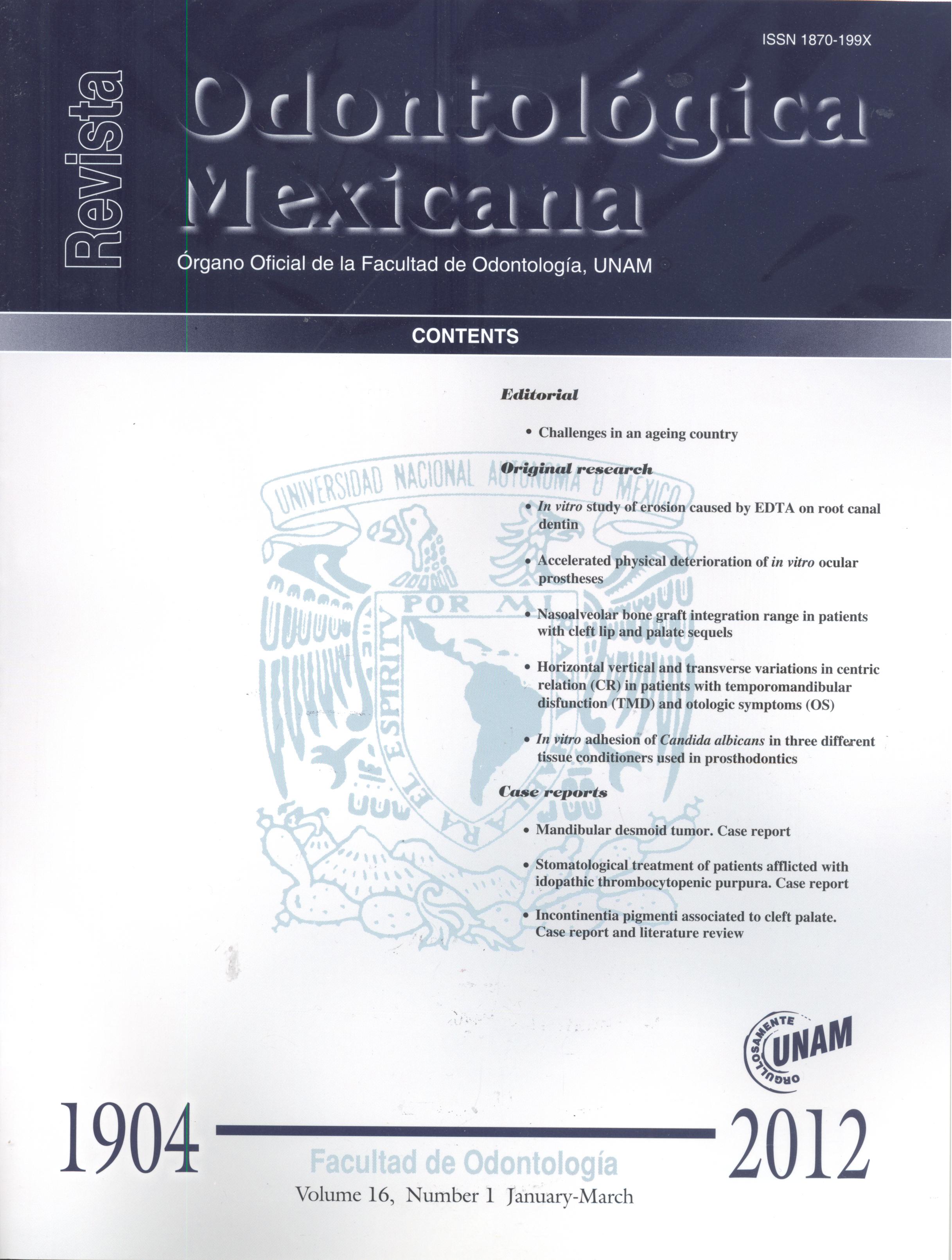
Nasoalveolar Bone Graft Integration Range in Patients with Cleft Lip and Palate Sequels
Barra lateral del artículo
Contenido principal del artículo
Resumen
Introduction:
Cleft lip and palate are growth and development conditions accounting for 15% of congenital malformations, and are associated to external and internal factors. One of the most linked sequels to this condition is the nasoalveolar cleft (NAC). Treatment for this condition is generally based on a periosteal surgery or a bone graft. These can be classified according to the age or time when they are administered, as well as to the type or nature of the material used.
Objective
To determine bone integration extent in nasoalveolar secondary bone grafts, obtained from the iliac crest in patients with unilateral cleft palate and lip sequels (CPLS) surgically treated following DrPhillipe Boyne`s technique, published in 1972. These patients were treated at the Maxillofacial Surgery Service of the Mexico s Children Hospial, Federico Gomez.
Methods
104 clinical and radiographic files of unilateral CPLS patients were examined. Patients age range was 7 to 14 years. Patients were classified according to the following criteria : gender, age, side of the cleft and development of complications. Grafts were radiographically evaluated, height with respect to the nasal floor was determined, and grafts were classified according to publications by Brusati and Garattin in 2000.
Results
A dependence was established between the extent of bone integration and the development of complications. No other dependence was observed in any of the variables.
Conclusions
In the sample of studied population, Dr Philippe Boynes technique for reconstruction of NAC and CPLS with extirpation and application of the iliac crest was very effective since adequate amounts of bone integration were achieved.
Downloads
Detalles del artículo
Cómo citar
Esta licencia permite a los usuarios copiar y distribuir el material en cualquier medio o formato, siempre que sea sin adaptaciones, con fines exclusivamente no comerciales y siempre que se mencione al autor. La licencia CC BY-NC-ND incluye los siguientes elementos:
BY: Se debe mencionar al autor.
NC: Solo se permite el uso no comercial de la obra. Por «no comercial» se entiende que no está destinado ni orientado principalmente a obtener un beneficio comercial o una compensación económica.
ND: No se permiten derivados ni adaptaciones de tu obra.