
In Vitro Adhesion of Candida albicans in Three Different Tissue Conditioners Used in Prosthodontics
Barra lateral del artículo
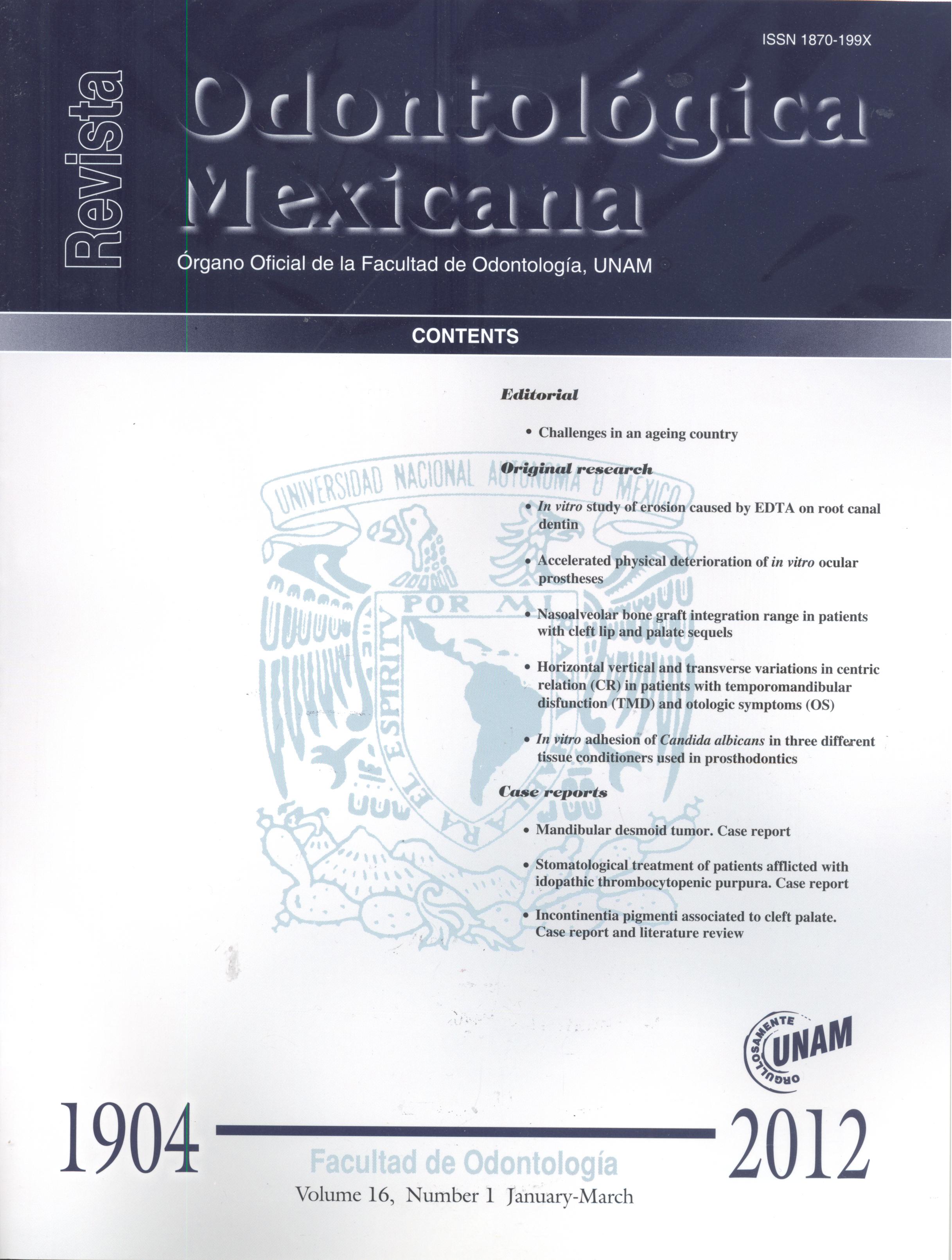
Contenido principal del artículo
Resumen
Background: Tissue conditioners are materials used on the surface of denture bases for 4 to 7 days. These materials have an irregular surface, and if improperly used, there is the possibility of adherence of some microorganisms such as Candida albicans which could elicit Oral Candidiasis.
Objective: To quantify and analyze three tissue conditioners with the aid of an Optical Microscope (OM) as well as a Scanning Electron Microscope (SEM) at three inoculation phases (days)
Study:36 study samples were prepared through inoculation of in vitro Candida albicans at 24, 72 and 168 hour intervals. Samples were assessed through OM and SEM from which photographs were obtained at 500x, 2,000x and 5,000x magnifications.
Results Coe Comfort tissue conditioner presented an even surface with budding yeast adhesion and hyphae; Lynal presented a 3µ cracked surface at 72 and 168 hours with budding yeast; Flexacryl Presented a 4µ cracked surface at 72 and 168 hours and great amounts of budding yeasts.
Conclusions: Coe Comfort conditioner presents a more regular surface with less Candida albicans adhesion, whereas Flexacryl is the one presenting greater irregularities and Candida albicans adherence in its surface.
Downloads
Detalles del artículo
Cómo citar
Esta licencia permite a los usuarios copiar y distribuir el material en cualquier medio o formato, siempre que sea sin adaptaciones, con fines exclusivamente no comerciales y siempre que se mencione al autor. La licencia CC BY-NC-ND incluye los siguientes elementos:
BY: Se debe mencionar al autor.
NC: Solo se permite el uso no comercial de la obra. Por «no comercial» se entiende que no está destinado ni orientado principalmente a obtener un beneficio comercial o una compensación económica.
ND: No se permiten derivados ni adaptaciones de tu obra.