
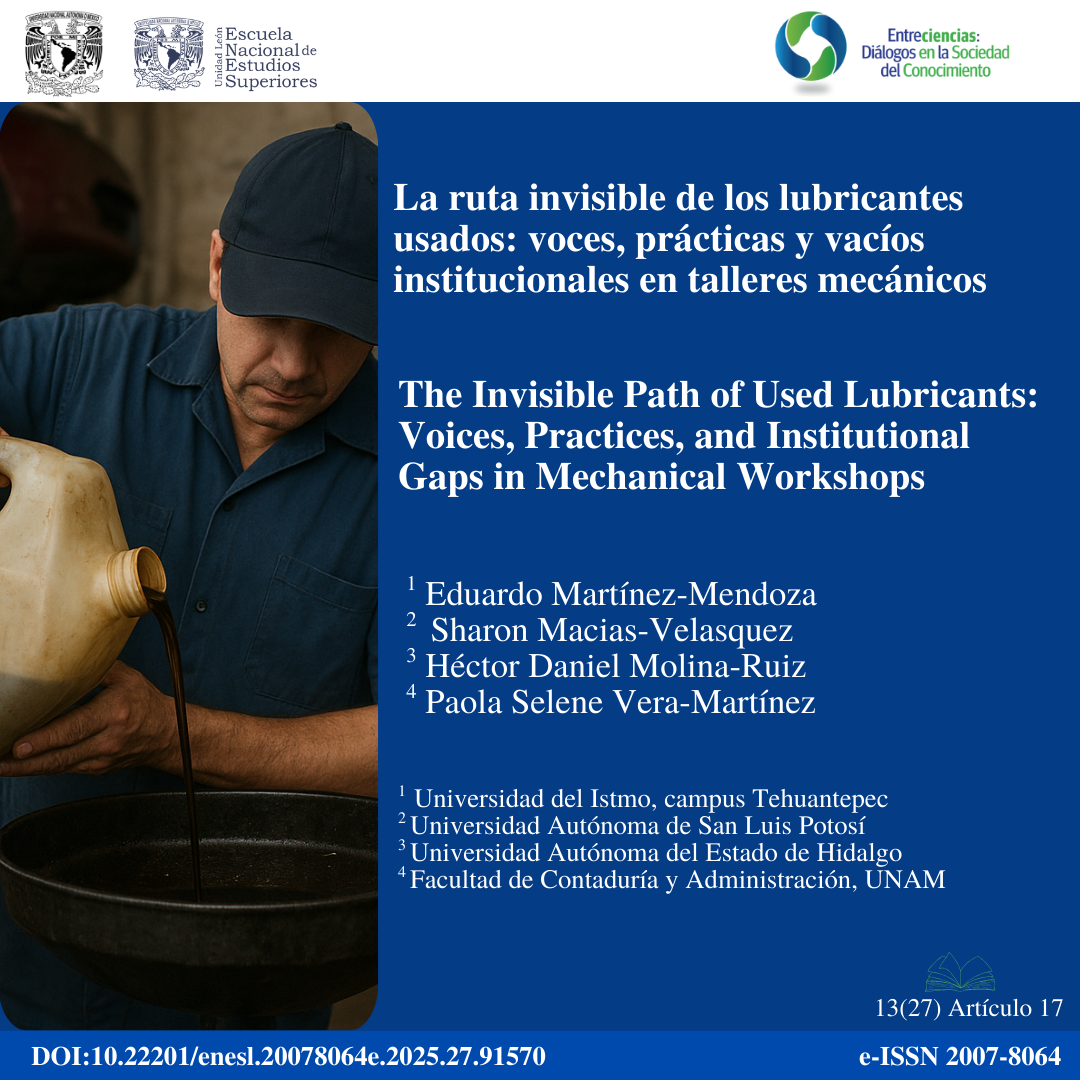
La ruta invisible de los lubricantes usados: voces, prácticas y vacíos institucionales en talleres mecánicos
Barra lateral del artículo
Contenido principal del artículo
Resumen
Propósito: describir las dinámicas que existen entre los actores inmersos en el manejo y disposición final de los lubricantes automotrices usados, a partir de las percepciones existentes en los talleres mecánicos.
Diseño metodológico: el estudio presenta un enfoque mixto. Se realizaron 25 entrevistas en diferentes talleres mecánicos, el tamaño de muestra se definió por saturación de las categorías de análisis.
Resultados: en los talleres mecánicos, aunque se desconoce con certeza el impactos de los lubricantes usados [LU], se cree que contaminan el medio ambiente y son riesgosos para la salud. Los talleres presentan disposición para colaborar en una estrategia de gestión responsable.
Limitaciones de la investigación: los resultados se limitan a un estudio exploratorio, se recomienda complementarse con estudios de caso en otros municipios de la región, e incluir a otros actores locales.
Hallazgos: no existe un plan institucional para el manejo de los lubricantes usados, los actores locales están desarticulados, se requiere capacitar a los talleres locales en el manejo de los residuos.
Descargas
Detalles del artículo
Citas en Dimensions Service


Citas
Acosta, A., Padilla, J. A., Zepeda-Domínguez, J. A., y Ojeda-Benitez, S. (2024). Percepción acerca del manejo responsable de los aceites LU: una aplicación de red semántica natural. Revista Internacional de Contaminación Ambiental, 40, 503-513. https://doi.org/10.20937/RICA.55068 DOI: https://doi.org/10.20937/RICA.55068
Aguilera, M. M., Ávila, V., Saucedo, G. A., y Sánchez, O. (2024). Diagnóstico ambiental del manejo de residuos peligrosos en talleres mecánicos. Un caso de estudio en México. Ciencia Latina Revista Científica Multidisciplinar, 8 (4), 4979-5003. https://doi.org/10.37811/cl_rcm.v8i4.12722 DOI: https://doi.org/10.37811/cl_rcm.v8i4.12722
Arciniega-Galaviz, M. A., Chavira-Lucero, Y. J., Montiel-Soto, I. A., y Peñuelas-Castro, L. I. (2019). Estudio del manejo de los residuos peligrosos generados en los talleres automotrices de la ciudad de Los Mochis, Sinaloa, México. International Journal of Innovation and Applied Studies, 27 (2), 475-480. http://www.ijias.issr-journals.org/
Almeida, D., Arteaga, A., Gallo-Cordova, A., Hidrobo, A., y Ponce, S. (2023). Chemical Recycling of Used Motor Oil by Catalytic Cracking with Metal-Doped Aluminium Silicate Catalysts. Sustainability, 15 (13), 10522. https://doi.org/10.3390/su151310522 DOI: https://doi.org/10.3390/su151310522
Alvarez-Rivera, J. A., Castañón-Nájera, G., Urrieta-Saltijeral, J. M., Laínes-Canepa, J. R., Hernández-Barajas, J. R., Pampillón-González, L., y Morales-Bautista, C. M. (2022). Handling of used lubricating oil in Tabasco, Mexico. DYNA, 89 (223), 121-126. https://doi.org/10.15446/dyna.v89n223.101484 DOI: https://doi.org/10.15446/dyna.v89n223.101484
Arner, A. (2022). The Extended Producer Responsibility for Waste Oils. International Journal of Energy Economics and Policy, 12 (2), 210-217. https://doi.org/10.32479/ijeep.12765 DOI: https://doi.org/10.32479/ijeep.12765
Atlas.ti. (2023). Análisis de Sentimiento en ATLAS.ti Web. https://atlasti.com/es/research-hub/analisis-de-sentimiento-en-atlas-ti-web
Barreda, A. (2017). Economía Política de la actual basura neoliberal. En M. F. Solíz (ed.), Ecología política de la basura (pp. 93-118). Abya-Yala.
Banamex (2021). Índice de ciudades sostenibles 2021. https://www.banamex.com/resources/pdf/es/personas/compromiso-social/indice-de-ciudades-sostenibles-2021.pdf
Bogarin, M. (2023). Conocimiento ambiental y actitud hacia la conservación del medio ambiente en estudiantes de educación primaria, Tocache, San Martin. Quintaesencia, 14 (1), 08-14. https://doi.org/10.54943/rq.v14i.367 DOI: https://doi.org/10.54943/rq.v14i.367
Canadian Council of Ministers of the Environment [CCME]. (2009). Canada-wide action plan for extended producer responsibility. https://CCME.ca/en/res/cap-epr_e.pdf
Chanchí, G. E., Hernández, C. E., y Sierra, L. M. (2021). Análisis de sentimientos sobre la percepción de los participantes de una feria virtual de emprendimiento durante el confinamiento. Investigación e Innovación en Ingenierías, 9 (3), 32-45. https://doi.org/10.17081/invinno.9.3.5316 DOI: https://doi.org/10.17081/invinno.9.3.5316
Diario Oficial de la Unión Europea. (2018). Directiva (UE) 2018/851 del Parlamento Europeo y del Consejo. https://eur-lex.europa.eu/legal-content/ES/TXT/PDF/?uri=CELEX:32018L0851
Diario Oficial de la Federación [DOF]. (2014). Reglamento de la Ley General para la Prevención y Gestión Integral de los Residuos. Diario Oficial de la Federación. https://www.diputados.gob.mx/LeyesBiblio/regley/Reg_LGPGIR_311014.pdf
Diario Oficial de la Federación [DOF]. (2023). Ley General para la prevención y gestión integral de los residuos. Diario Oficial de la Federación. https://www.diputados.gob.mx/LeyesBiblio/pdf/LGPGIR.pdf
Diario Oficial de la Federación [DOF]. (2024). Ley General del Equilibrio Ecológico y la Protección al Ambiente. Diario Oficial de la Federación. https://www.diputados.gob.mx/LeyesBiblio/pdf/LGEEPA.pdf
Durand-Smith, L., Figueroa-Díaz, F., y Guzmán-Chávez, M. G. (2011). La ecología política en México ¿Dónde estamos y para dónde vamos? Estudios Sociales, 19 (37), 283-307. https://www.scielo.org.mx/pdf/estsoc/v19n37/v19n37a11.pdf
Espinoza-Cisneros, E., y Rojas-Marchini, F. (2025). Geografía, ecología política y el cambio transformativo en el siglo XXI. Revista Geográfica de América Central, 1 (74). https://doi.org/10.15359/rgac.74-1.13 DOI: https://doi.org/10.15359/rgac.74-1.13
Esquivel-Grados, J. (2025). Saturación de la información. Tamaño de muestra según diseños de investigación cualitativa. Edutech Review, 10 (1), 1-9. https://edulab.es/revEDUTECH/article/view/5460
Expósito, D., y González, J. A. (2017). Sistematización de experiencias como método de investigación. Gaceta Médica Espirituana, 19 (2), 75-91. http://scielo.sld.cu/pdf/gme/v19n2/GME03217.pdf
Flores, C., y Herrera-Reyes, L. (2010). Estudio sobre las percepciones y la educación ambiental. Tiempo de Educar, 41 (22), 227-249. https://www.redalyc.org/pdf/311/31121072004.pdf
Franklin, M., y Simmons, D. (2013). An Investigation into the Advancement of Polyethylene Terephthalate (PET) Beverage Bottle Recycling in Georgetown, Guyana. SEES Research Series: Student Research Articles and Practitioner Essays on the Green Economy, 1 (1), 35-44. https://doi.org/10.52377/YDEK3267 DOI: https://doi.org/10.52377/YDEK3267
Freire-Rosero, R. del P., Ramos-Flores, J. M., Bravo-Morocho, W. M., y Padilla-Padilla, C. A. (2020). Tratamientos químicos y fisicoquímicos para aceites residuales de sistemas automotrices. Polo del Conocimiento, 5 (8), 1014-1029. https://polodelconocimiento.com/ojs/index.php/es/article/view/1641
Freré, J. S., Véliz, J. P., Sarco, E. M., y Campoverde, K. J. (2022). La percepción, la cognición y la interactividad. RECIMUNDO, 6 (2), 151-159. https://doi.org/10.26820/recimundo/6.(2).abr.2022.151-159 DOI: https://doi.org/10.26820/recimundo/6.(2).abr.2022.151-159
García-Sánchez, S., Juárez-Agis, A., Maldonado-Astudillo, R. I., Olivier-Salomé, B., Zeferino-Torres, J., Torres-Espino, G., y Rivas-González, M. (2023). Situación actual y cumplimiento de la normatividad sobre residuos peligrosos en talleres mecánicos en la Colonia Progreso, Acapulco, Guerrero, México. Acta Universitaria, 33, 1-12. https://www.scielo.org.mx/pdf/au/v33/2007-9621-au-33-e3747.pdf DOI: https://doi.org/10.15174/au.2023.3747
Gobierno del Estado de Oaxaca. (2023). Zona Metropolitana de Tehuantepec. de https://www.oaxaca.gob.mx/zona-metropolitana/
González, G., Ahumada-Cervantes, R., Ahumada-Cervantes, B., González-Márquez, L., y García-Urquidez, D. (2020). El manejo de aguas residuales y residuos peligrosos en talleres mecánicos en la ciudad de Guasave, Sinaloa, México. Revista Bio Ciencias, 7, e991. https://doi.org/10.15741/revbio.07.e991 DOI: https://doi.org/10.15741/revbio.07.e991
González, M. E., Vera, J. I., y Hernández, S. (2021). Estudio de la percepción ambiental geográfica de la contaminación de un arroyo urbano, Tonalá, Chiapas. Región y Sociedad, 33, e1510. https://doi.org/10.22198/rys2021/33/1510 DOI: https://doi.org/10.22198/rys2021/33/1510
Google Maps. (2025). Tehuantepec, Oaxaca, México [Mapa]. https://maps.app.goo.gl/tPZBJx6NL3Ub28vKA
Guerra-Reyes, F., Naranjo-Toro, M., Basantes-Andrade, A., y Guerra-Dávila, E. (2023). Fortalecimiento de la formación de los estudiantes de Educación Básica como aprendices de investigador. Horizontes. Revista de Investigación en Ciencias de la Educación, 7 (27), 113-126. https://doi.org/10.33996/revistahorizontes.v7i27.501 DOI: https://doi.org/10.33996/revistahorizontes.v7i27.501
Gutberlet, J., Rizpah, G., y Morais, L. (2020). Participatory solid waste governance and the role of social and solidarity economy: experiences from São Paulo, Brazil. Detritus, 13, 167-180. https://doi.org/10.31025/2611-4135/2020.14024 DOI: https://doi.org/10.31025/2611-4135/2020.14024
Hanoshenko, O., Stepova, O., Chukhlib, Y., Kostiantyn, L., Yanovych, Y., y Bilotserkivska, N. (2021). Environmentally friendly disposal of used automotive oil filters: legislative aspects and technology. Ecological Questions, 32 (3), 77-89. https://apcz.umk.pl/EQ/article/view/34433 DOI: https://doi.org/10.12775/EQ.2021.026
Hendra, H., y Arisanty, D. (2025). Political Ecology Evaluation of Waste Management Policy in Banjarmasin City. Asian Journal of Environmental Research, 2 (2), 127-135. https://doi.org/10.69930/ajer.v2i2.368 DOI: https://doi.org/10.69930/ajer.v2i2.368
Hernández, A., Bocija, J., García, J., Rubini, S., y Laens, V. (2025). Ecología política, agroecología y sus expresiones en lo local: Barrios Verdes. En Municipio B y Doble Clic Eds., Cuidar nos transforma. Experiencias y desafíos vinculados al Plan de Cuidados del Municipio B (pp. 149-166).
Hernández, S. (2019, octubre 22). Pobres o nulos los avances para reciclar lubricantes en México: especialista. El Sol de Toluca. https://www.elsoldetoluca.com.mx/finanzas/pobres-o-nulos-los-avances-para-reciclar-lubricantes-en-mexico-especialista-4352434.html
Heshmati, A. (2015). A Review of the Circular Economy and its Implementation (IZA Discussion Paper No. 9611). Institute of Labor Economics. https://docs.iza.org/dp9611.pdf
Ibor-Chadid, L. I., Garrido-Gómez, Y., Rodríguez-Rodríguez, S., y Santana-Sarmiento, H. J. (2025). Valores ambientales: Un estudio sobre las actitudes y los comportamientos de los estudiantes universitarios frente a la conservación del medioambiente. Tejidos Sociales, 7 (1), 1-12. https://revistas.unisimon.edu.co/index.php/tejsociales/article/view/8312/6952
Instituto Nacional de Estadística y Geografía [Inegi]. (2014). Directorio Nacional de Unidades Económicas-DENUE. https://www.inegi.org.mx/programas/ce/2014/
Instituto Nacional de Estadística y Geografía [Inegi]. (2023a). Clasificadores - Catálogo SCIAN. https://www.inegi.org.mx/scian/
Instituto Nacional de Estadística y Geografía [Inegi]. (2023b). Parque vehicular. https://www.inegi.org.mx/temas/vehiculos/#tabulados
Instituto Nacional de Estadística y Geografía [Inegi]. (2025). Banco de Información Económica (BIE). https://en.www.inegi.org.mx/app/indicadores/?tm=0
Kapustina, V., Havukainen, J., Virkki-Hatakka, T., y Horttanainen, M. (2014). System analysis of waste oil management in Finland. Waste Management & Research: The Journal for a Sustainable Circular Economy, 32 (4), 297-303. https://doi.org/10.1177/0734242X14523663 DOI: https://doi.org/10.1177/0734242X14523663
Lee, H., Sakamoto, Y., y Yoshizawa, Y. (2023). Analysis of information to promote participation in waste separate collection: Used cooking oil in Japan. Cleaner Waste Systems, 6, 100119. https://doi.org/10.1016/j.clwas.2023.100119 DOI: https://doi.org/10.1016/j.clwas.2023.100119
Leeuwerik, R. N. C., Kwong, Y. M. C., y Fujitani, M. (2025). The politics of knowledge use in wastewater management – A systematic literature review. Frontiers in Environmental Science, 13. https://doi.org/10.3389/fenvs.2025.1614208 DOI: https://doi.org/10.3389/fenvs.2025.1614208
López, R. R. (2019). Análisis de Sentimientos en textos de opinión. Una evaluación práctica. Plaza y Valdés.
Mahajan, K. (2022, marzo 28). Here’s How Countries Around the Globe Are Handling Used Oil. https://klinegroup.com/how-countries-around-the-globe-are-handling-used-oil/
Manzanarez, L. A. (2022). Alternativas de recuperación para los aceites lubricantes usados. EPISTEMUS, 16 (32). https://doi.org/10.36790/epistemus.v16i32.222 DOI: https://doi.org/10.36790/epistemus.v16i32.222
Miglio, M. (2022). Eco Panplas: better recycling of lubricant containers. WIPO Magazine. https://www.wipo.int/wipo_magazine/en/2022/02/article_0007.html
Mordor Intelligence. (2025). Tamaño del mercado de lubricantes y análisis de participación tendencias de crecimiento y pronóstico (2024-2029). https://www.mordorintelligence.com/es/industry-reports/lubricants-market
Naré, R. W. A., Sogli, T., Sawadogo, I. T. C., y Erinle, O. K. (2019). Management of used engine oil in auto and motor repair garages in Ouagadougou, Burkina Faso. International Journal of Advanced Research, 7 (11), 652-658. https://doi.org/10.21474/IJAR01/10054 DOI: https://doi.org/10.21474/IJAR01/10054
Nowak, P., Kucharska, K., y Kamiński, M. (2019). Ecological and Health Effects of Lubricant Oils Emitted into the Environment. International Journal of Environmental Research and Public Health, 16 (16), 3002. https://doi.org/10.3390/ijerph16163002 DOI: https://doi.org/10.3390/ijerph16163002
Nuela, F., Verdesoto, S., y Morales, D. (2025). Actitudes, percepciones y predisposición de jóvenes universitarios en la economía circular. UTC Prospectivas: Revista de Ciencias Administrativas y Económicas, 8 (2), 23-32. https://doi.org/10.61236/utcprospectivas.v8i2.1121 DOI: https://doi.org/10.61236/utcprospectivas.v8i2.1121
Padilla, C. A., Audelo, M. E., Buenaño, L. F., y Sánchez, D. M. (2022). Evaluación de la contaminación de aceites lubricantes en el piso de talleres y lubricadoras automotrices caso: ciudad de Riobamba. Dominio de Las Ciencias, 8 (2), 1626-1644. https://dominiodelasciencias.com/ojs/index.php/es/article/view/2890
Pinheiro, C. T., Quina, M. J., y Gando-Ferreira, L. M. (2021). Management of waste lubricant oil in Europe: A circular economy approach. Critical Reviews in Environmental Science and Technology, 51 (18), 2015-2050. https://doi.org/10.1080/10643389.2020.1771887 DOI: https://doi.org/10.1080/10643389.2020.1771887
Reyes, O., Espinosa, R., y Olvera, R. (2019). Criterios para Determinar el Tamaño de Muestra en Estudios Descriptivos. Congreso Internacional de Investigación, 5 (3), 2919-2924. https://www.researchgate.net/profile/Octavio-Reyes-Lopez/publication/333531364_Criterios_para_determinar_el_Tamano_de_Muestra_en_Estudios_Descriptivos/links/5cf202e7299bf1fb184e8df5/Criterios-para-determinar-el-Tamano-de-Muestra-en-Estudios-Descriptivos.pdf
Robbins, P. (2012). Political Ecology (2da. Ed.). John Wiley & Sons.
Sarkar, S., Datta, D., Chowdhury, S., y Das, B. (2022). Comprehensive analysis of reclamation of spent lubricating oil using green solvent: RSM and ANN approach. Chemical and Process Engineering, 43 (2), 119-135. https://doi.org/10.24425/cpe.2022.140815 DOI: https://doi.org/10.24425/cpe.2022.140815
Secretaría de Economía. (2025). Catálogo Mexicano de Normas. https://platiica.economia.gob.mx/normalizacion/catalogo-mexicano-de-normaswd_asp-id29/
Secretaría de Medio Ambiente y Recursos Naturales []. (2022). Trámites relacionados al tema de residuos peligrosos. https://www.gob.mx/semarnat/acciones-y-programas/tramites-relacionados-al-tema-de-residuos-peligrosos
Sistema de Gestión de Aceites Industriales usados en España [Sigaus]. (2023). La factura del taller. https://www.sigaus.es/factura-del-taller
Société De Gestion Des Huiles Usagées. [Soghu]. (2022). Map and RI with rates of June 01, 2022. https://soghu.com/wp-content/uploads/02-QC-20.01.01-Map-and-RI.pdf
Statista. (2023). Market value of automotive lubricants worldwide in 2020 and 2021, with a forecast until 2030. https://www.statista.com/statistics/1256358/global-automotive-lubricants-market-size/
Stroud, L., Green, E., y Cronje, J. (2020) A Revision Process That Bridges Qualitative and Quantitative Assessment. Psychology, 11, 436-444. DOI: 10.4236/psych.2020.113029 DOI: https://doi.org/10.4236/psych.2020.113029
Syahir, A. Z., Zulkifli, N. W. M., Masjuki, H. H., Kalam, M. A., Alabdulkarem, A., Gulzar, M., Khuong, L. S., y Harith, M. H. (2017). A review on bio-based lubricants and their applications. Journal of Cleaner Production, 168, 997-1016. https://doi.org/10.1016/j.jclepro.2017.09.106 DOI: https://doi.org/10.1016/j.jclepro.2017.09.106
Tasnim, A., Abha, A. T., Naghibalsadati, F., Tam, E., y Ng, K. T. W. (2025). Management Assessment of used Oil, Filters, and containers in the Canadian automotive sector using resource recovery metrics. Waste Management, 191, 284-293. https://doi.org/10.1016/j.wasman.2024.11.020 DOI: https://doi.org/10.1016/j.wasman.2024.11.020
Tejada, C. N., Quiñones, E., y Fong, W. (2017). Physical-chemical caracterization of spent engine oils for its recycling. Prospectiva, 15 (2), 135-144. https://doi.org/10.15665/rp.v15i2.782 DOI: https://doi.org/10.15665/rp.v15i2.782
The European Commission. (2010). Amending Regulation (EC) No 2150/2002. https://eur-lex.europa.eu/eli/reg/2010/849/oj/eng
Used Oil Management Associations of Canada. [UOMA]. (2023). The UOMA Industry-Led Stewardship program model works environmentally, economically and socio-economically. https://usedoilrecycling.com/about-us/
Vargas-Garduño, M., Méndez, A., y Vargas, A. (2014). La técnica de las redes semánticas naturales modificadas y su utilidad en la investigación cualitativa. IV Encuentro Latinoamericano de Metodología de las Ciencias Sociales. Facultad de Humanidades y Ciencias de la Educación (Fahce), Buenos Aires. https://www.memoria.fahce.unlp.edu.ar/trab_eventos/ev.8204/ev.8204.pdf
Vivas, J. R., Comesaña, A., y Vivas, L. Y. (2007). Evaluación de las redes semánticas de conceptos académicos en estudiantes universitarios. PsicoUSF, 12 (1), 111-119. https://www.redalyc.org/articulo.oa?id=401041439013 DOI: https://doi.org/10.1590/S1413-82712007000100013

Esta obra está bajo una licencia internacional Creative Commons Atribución-NoComercial-SinDerivadas 4.0.

Entreciencias: Diálogos en la Sociedad del Conocimiento reconoce y respeta el derecho moral de los autores, así como la titularidad del derecho patrimonial, transferida de forma no exclusiva a la revista para su difusión en acceso abierto y su preservación, por lo que los autores que publiquen en esta revista aceptan las siguientes condiciones:
- Entreciencias: Diálogos en la Sociedad del Conocimiento por Universidad Nacional Autónoma de México se distribuye bajo una Licencia Creative Commons Atribución-NoComercial-SinDerivar 4.0 Internacional, la cual permite utilizar la información y los metadatos sin fines comerciales siempre y cuando se realice la citación correspondiente.
- Los autores tendrán el derecho de realizar la distribución no exclusiva de la contribución publicada en Entreciencias: Diálogos en la Sociedad del Conocimiento, es decir, podrán incluirlo en un repositorio institucional o darlo a conocer en otros medios digitales o impresos, siempre y cuando se indique que el artículo fue publicado por primera vez en Entreciencias: Diálogos en la Sociedad del Conocimiento, y además se incluyan datos como: autor de correspondencia, año, volumen, número de páginas, paginación electrónica y DOI.
- Los autores cuyas contribuciones sean aceptadas para su publicación deberán enviar la Carta de Cesión de Derechos en el formato llenado y firmado según corresponda, es decir, de un autor, o de dos o más autores.